
Training by Building: Dual Training at Nyamira National Polytechnic
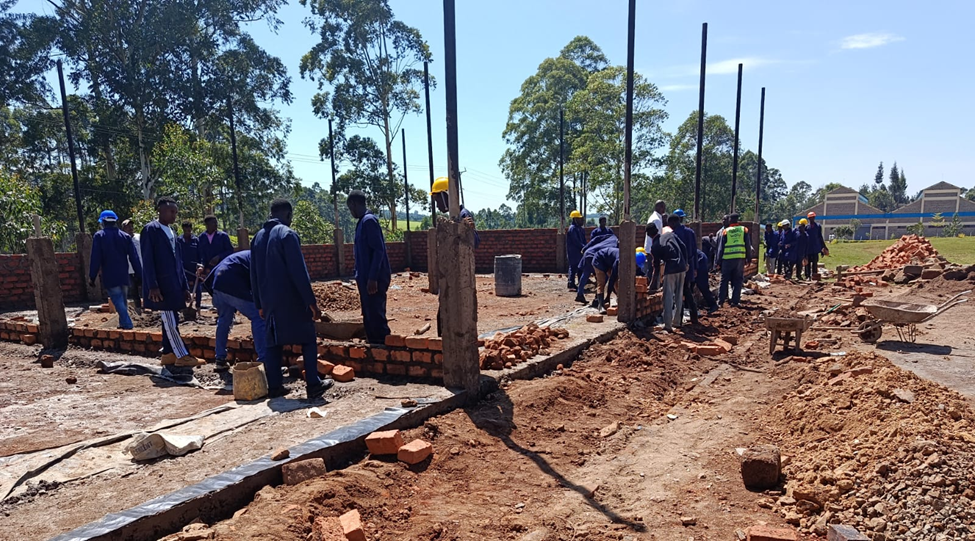
Trainees in Building and Civil Engineering are constructing their own workshop, learning the trade by doing the real work.
For years, the skills mismatch has been described as one of the major obstacles to skills development and youth employment in Kenya. Graduates leave training with certificates, yet employers often find a gap between what was taught and what the job requires, and too many young people are left waiting for their first opportunity. The dual training model, approved by the Government in 2025, responds to this challenge by placing learning where real work happens.
At Nyamira National Polytechnic, that idea is visible on the ground. Trainees in Building and Civil Engineering are constructing the institution's new workshop themselves, laying bricks, raising walls and working under supervision on a live site. The classroom has moved onto the construction site.
For Mr. Wilfred Mokaya, a trainer in the Building and Civil Engineering department, the difference is personal. He says he never had the chance to work on a real building when he was a trainee, and he considers his current trainees fortunate to have that experience. That opportunity is no accident. It is the result of a deliberate shift towards training that is practical, supervised and tied to real work.
Competence that is demonstrated, not just taught
Training by building is more than hands-on practice. Each task carries a standard, and trainees compile a portfolio of evidence showing what they have done and how well they have done it. This is the principle of Competency-Based Education and Training: competence is proven by performing the task, not by describing it.
For the trainees, the effect is tangible. Confidence grows with every completed task, and the skills they stack up become a stepping stone to further learning and work. The workshop also serves as proof of concept. It shows that trainees can build, and that the quality of their workmanship can stand up in a real structure.
A benefit to institutions and to the economy
The approach also supports institutional sustainability. When an institution builds its own facilities through training, infrastructure development and skills development advance together, and the result is a workshop that will train the next cohort.
It helps ease another persistent bottleneck: access to industry attachment and internship placements. Industry cannot always absorb every trainee. When an institution's own development projects become learning sites, more trainees can gain workplace-style experience, and pressure on the limited attachment slots in industry eases.
Why it matters
This speaks directly to the mandate of the State Department for Technical and Vocational Education and Training: to develop a skilled, competent workforce that drives Kenya's economic transformation and its ambition of middle-income status. That mandate is not fulfilled through policy alone. It is fulfilled through institutions that put practical training at the centre of everything they do, and through a deliberate effort to ensure that, wherever possible, every institutional activity serves both learning and development.
Nyamira National Polytechnic shows what that looks like in brick and mortar. The workshop rising on its grounds is not just a building. It is the mandate made visible: trainees are not waiting for their careers to begin, they are laying the very foundation of them. And as Mr. Mokaya observes, it is an experience that earlier generations of trainees rarely had.